
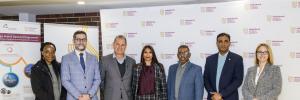
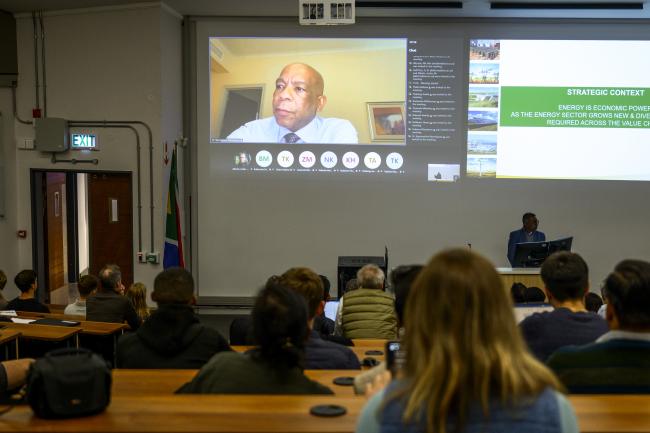
Prof Sibusiso Moyo, Deputy Vice-Chancellor (VC): Research, Innovation and Postgraduate Studies; Prof Geo Quinot, Pro-VC: Government Partnerships, and Professor Prof Wikus van Niekerk, Dean of the Faculty of Engineering and Pro-VC: Institutional Efficiency; Dr Kubeshnie Bhugwandin, Renewables Manager at Eskom; Mr Subesh Pillay, Deputy Director-General of Department of Electricity and Energy; Prof Deresh Ramjugernath, SU Rector and Vice-Chancellor and Prof Cristina Trois, Director of the Centre for Renewable and Sustainable Energy Studies (CRSES) ahead of the ministerial engagement, and online presentation by Minister of Electricity and Energy, Dr Kgosientsho Ramokgopa.
Universities key to SA’s energy transition, Ramokgopa tells SU
- Minister of Electricity and Energy Dr Kgosientsho Ramokgopa engaged with staff and students at Stellenbosch University (SU) as part of the Department of Electricity and Energy’s national energy skills outreach programme.
- Universities play a critical role in preparing the next generation of specialists need to expand the country’s skills base.
- SU, through its Centre for Renewable and Sustainable Energy Studies (CRSES) and the Faculty of Engineering, has been identified as a key partner for government’s outreach to expand its skills base.
Minister of Electricity and Energy Dr Kgosientsho Ramokgopa says South Africa’s energy ambitions will depend on rapidly expanding the country’s engineering and technical skills base, with universities playing a critical role in preparing the next generation of specialists.
Speaking during an engagement with staff and students at Stellenbosch University (SU) as part of the Department of Electricity and Energy’s national energy skills outreach programme, Ramokgopa described energy as “the oxygen that breathes life into the economy” and cautioned that South Africa would not achieve energy security and sovereignty without investing in local expertise.
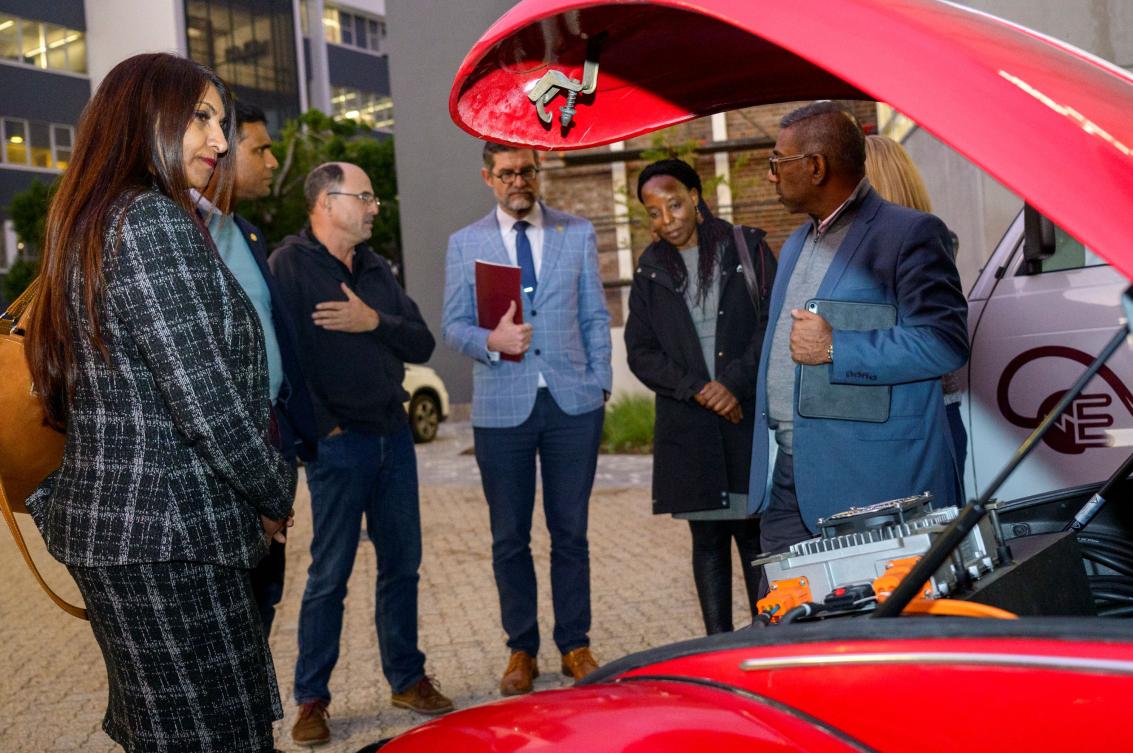
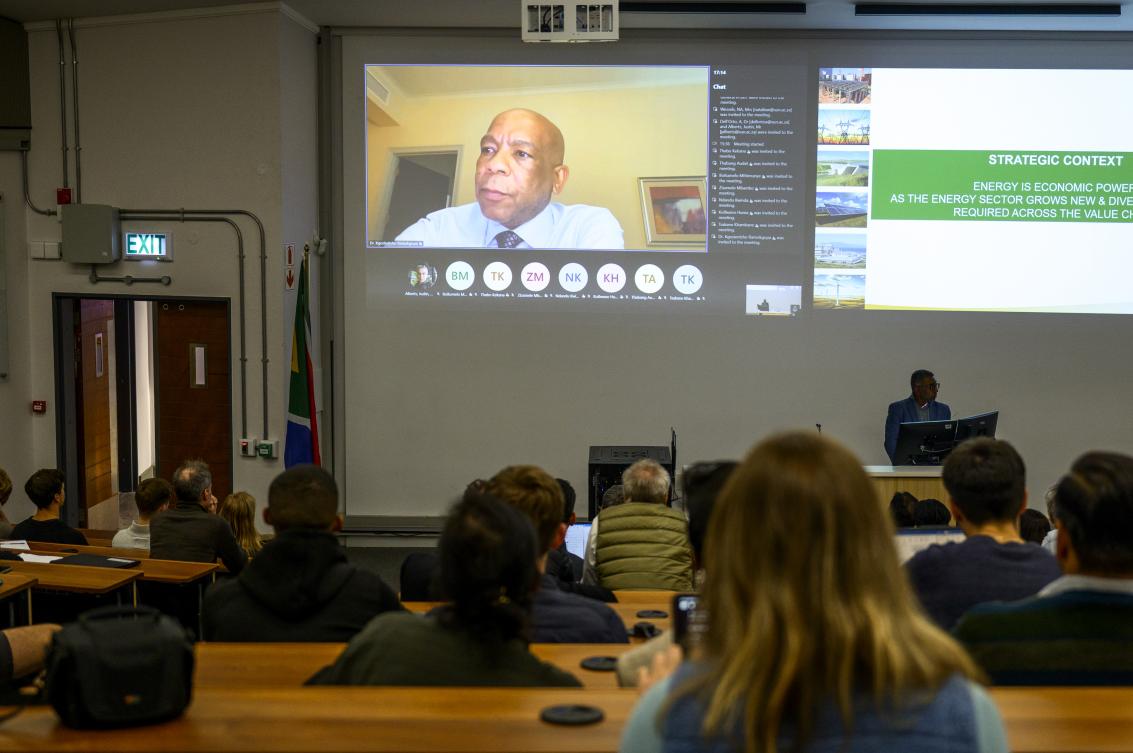
“The future is here,” he said during his virtual presentation, which was livestreamed to students, staff and members of the ministerial delegation who were present at SU’s Engineering Faculty.
As a leading institution of higher learning, SU through its Centre for Renewable and Sustainable Energy Studies (CRSES) and the Faculty of Engineering, has been identified as a key partner for government’s outreach to expand its skills base.
Referring to the link between electricity access and economic growth, Ramokgopa said low levels of energy consumption often reflected weak economic performance.
“If the lights are off, we are unlikely to grow the economy,” he said.
He added that South Africa would require a wide range of specialised skills across the energy value chain to sustain future growth.
Ramokgopa said government plans to position South Africa as a key player in the global green energy transition through grid expansion, renewable integration, the localisation of clean energy technologies and the incorporation of nuclear energy into the Just Energy Transition framework.
However, he noted that South Africa currently lacks the expertise needed to build nuclear reactors independently and would need to rely on countries such as France, China and Korea for that capability.
“We need to accelerate the pipeline of engineers,” he said, adding that the country already possesses many of the natural resources required to support its energy ambitions, including critical minerals and renewable energy potential.
He also highlighted opportunities for local manufacturing linked to the energy transition, including the production of pylons and transmission infrastructure.
Ramokgopa said around 400 000 annual on-grid and off-grid connections would be needed for South Africa to achieve universal electricity access by 2030. He added that South Africa was also well positioned to capture a share of growing global data-centre investment and become a gateway to the African market.
Ramokgopa emphasised that universities would play a pivotal role in shaping the human capital needed to design, build and operate the country’s future energy system.
“South Africa is not just transitioning its energy system; it is building the infrastructure backbone of Africa’s future power economy.”
Prof Geo Quinot, Pro-Vice-Chancellor: Government Partnerships at SU, welcomed the ministerial engagement, saying Ramokgopa’s presentation raised questions central to both government and higher education institutions.
These include how to develop skills required for a changing energy landscape, align research with national priorities, and ensure that this transition is both just and sustainable, while being in service of society.
“I want to assure you that at SU we see our role very clearly in this regard. Through our Faculty of Engineering, and specifically our Centre for Renewable Energy and Sustainability Energy Studies, along with our broader research ecosystem, we are committed to contributing meaningfully to the country’s energy transition, equipping the next generation of engineers, scientists and policymakers who will stay here and develop our country and our continent.”
He also emphasised the importance of collaboration, saying that no single institution can meet this challenge alone. “The scale and complexity of South Africa's energy transition, demand strong partnerships between government, academia, industry and society. You and your colleagues’ engagement with us here today is therefore not only deeply welcomed, but also essential.”
In conclusion, Quinot said: “We hope that (this) engagement will deepen collaboration, sharpen our shared understanding of the skills pipeline required and open up new avenues of cooperation in support of energy security and long-term sovereignty.”
Related stories

Media release
People with Down syndrome must be included in conversations about their healthcare
People with Down syndrome and their families consistently value healthcare that is relational, respectful, and person-centred, rather than focused solely on...
Media release
SU scientist receives R14 million grant to tackle West Nile virus
As climate and environmental change continue to reshape ecosystems across the world, scientists are warning that mosquito-borne diseases may spread into new...
Media release
Many factors drive changes in human-wildlife relationships
Human populations are expanding and encroaching further into wildlife habitats, leading to dynamic and evolving relationships between humans and wildlife. As...